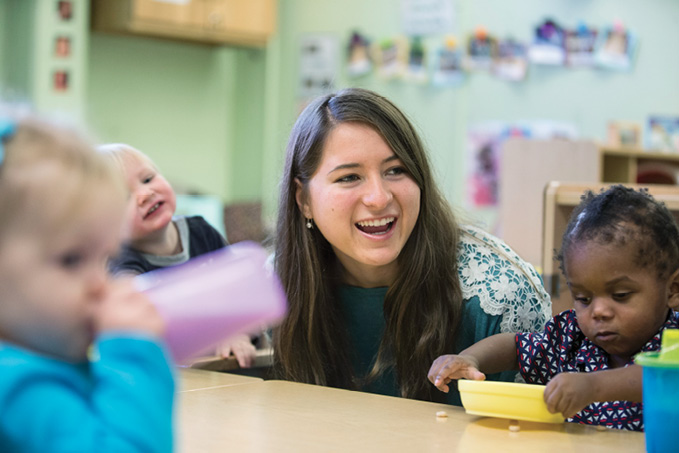
Children of all ability levels are immersed in a culture of acceptance at the , the first nationally recognized inclusive preschool. One-third of the students at SGS have an intellectual or physical disability.
The school provides a fertile training ground for a select cadre of graduate students in Peabody鈥檚 early childhood special education program. The Susan Gray fellows, who are generously supported by 杏吧原创 alumnus H. Rodes Hart, assist the teachers in each of the school鈥檚 eight classrooms.
Hart, who was instrumental in launching the fellowship, covers the fellows鈥� salaries and Peabody tuition.
鈥淭he Susan Gray School is particularly special to my wife Patricia and me, and we find deep joy in supporting the fellows program,鈥� Hart says. 鈥淭oday, the fellows play a critical role at the school by bringing fresh ideas and perspectives. Tomorrow, the fellows will be the leaders in the field鈥攃reating environments where all children, including those with developmental disabilities, can learn together side by side.鈥�
When Brandy Locchetta, M.Ed.鈥�14, became a Susan Gray fellow, she had spent 13 years in early childhood education. She now manages the Inclusion Program for the Georgia Department of Early Care and Learning. Locchetta believes her experiences at SGS prepared her to confidently interpret research, as well as create systems and procedures to support the state鈥檚 early-learning workforce.
鈥淚鈥檓 in a position to use my knowledge and experience to inform state initiatives and policy, which can ignite change that results in positive outcomes for young children and their families,鈥� Locchetta says.
A math coach for pre-K teachers in the New York City Department of Education鈥檚 Pre-K for All professional development tracks, Meghan Brennan, M.Ed.鈥�16, has found that her time at SGS allowed her to apply what she learned in her graduate studies to everyday experiences in the classroom.
鈥淎ll students, no matter how young, have their own special interests, strengths and goals, and it鈥檚 our job as teachers to find out what they are and build upon them,鈥� Brennan says. 鈥淭he master鈥檚 program and Susan Gray make this the forefront of the work we do with children, which is something I carry with me into each classroom I visit, each student I meet, and, most important, each teacher I work with.鈥�
Alexis Schulenburg, B.S.鈥�16, M.Ed.鈥�18 (anticipated), plans to become an early childhood teacher or applied behavior analyst for young children with disabilities. Her time as a fellow showed her the range of possible careers and prepared her well for her own classroom.
鈥淚鈥檓 highly qualified to work in either, and I鈥檓 equally excited to work in either,鈥� she says. 鈥淭his has been the most educational, challenging and empowering experience I could have asked for in a master鈥檚 program.鈥�
The Susan Gray School, originally named the Peabody Experimental School, opened in 1968 as an on-campus research-oriented school devoted to educational research involving young children with developmental disabilities and children whose future development was at risk because of conditions such as poverty. In 1986 the school was renamed the Susan Gray School in recognition of Susan Gray (1913鈥�1992), a pioneering Peabody faculty member and national authority on childhood early education.
By Jane Sevier
SaveSave