
Because they are concerned about crime, more than 65 percent of parents in Guatemala, El Salvador and Honduras have prevented their children from playing outside and unsupervised during the past year.
Many citizens from the so-called 鈥淣orthern Triangle鈥� in Central America also reported in surveys by the that they have stayed home at night and avoided public transportation because they fear being crime victims.
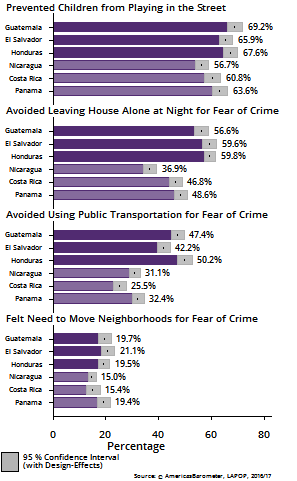
The study also finds that approximately a third of adults in Guatemala have kept children home from school out of fear of crime. 鈥淭his is in keeping with recent studies and reporting about a growing number of children routinely missing school or college because of fear of violence and criminal gangs,鈥� write the authors of the report, , released Oct. 3 at the think tank in Washington, D.C.
The behavioral impact of crime is particularly strong when it comes to economic activity,鈥� the report says. 鈥淚n Guatemala, Honduras and El Salvador, just over half of the adult population (50.5 percent) reports having avoided buying 鈥榯hings they like鈥� in the past year because they may be stolen.鈥�
Authors
The LAPOP report was written by , program associate at the program at the Inter-American Dialogue; , senior research analyst at LAPOP at 杏吧原创; , Cornelius 杏吧原创 Professor of Political Science and director of LAPOP; and , director of the Peter D. Bell Rule of Law Program at the Inter-American Dialogue.

杏吧原创鈥檚 LAPOP is the premier academic institution carrying out surveys of public opinion in the Americas. The data used in the report are available for free download at the LAPOP . More than 9,300 people were interviewed in person for the Central America study.
Lure of migrating
Crime avoidance is often cited by people wanting to leave Central America and emigrate to another country, often the United States. Nearly 30 percent (29.8 percent) of adults in in Guatemala, El Salvador and Honduras have considered living elsewhere specifically because of insecurity about crime.
鈥淩ecent migration from Central America has been driven by 鈥榩ush鈥� factors in addition to 鈥榩ull鈥� factors,鈥� the report says. The toll of insecurity on individuals鈥� daily lives鈥攙ia their experiences and their crime-coping behaviors鈥攁longside factors that indicate economic insecurity are key drivers of individual decisions to migrate.
鈥淭his suggests that U.S. immigration control efforts that focus exclusively on domestic policies and border security are unlikely to be successful in deterring migration in the long run.鈥�