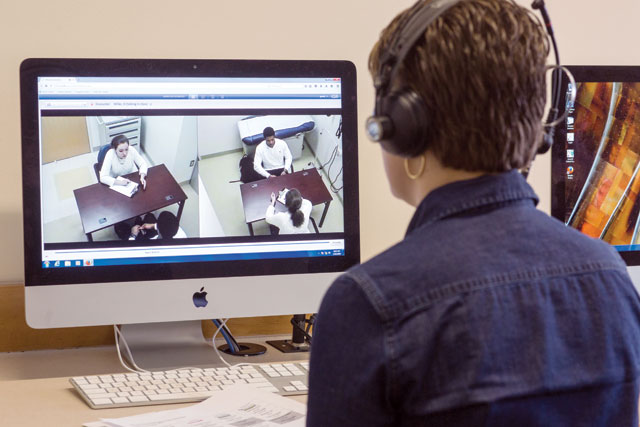
More than a decade and a half ago, , observed her husband going through training to become a physician at the University of Virginia. An important component of his preparation was participating in live-action simulations. Under the eye of a video camera he interacted with 鈥減atients鈥� (hired actors) to practice reacting gracefully to unexpected鈥攁nd potentially sensitive鈥攃linical situations.
Later, when Self became a Ph.D. candidate at Peabody, she wondered if a similar training might help teacher candidates become more culturally responsive to their students. For her dissertation, which she defended in February, Self conducted clinical simulations through a partnership with the Center for Experiential Learning and Assessment at 杏吧原创 Medical Center.
Over the course of three years, Self observed about 200 undergraduate and graduate students in about 600 simulations, using a dozen different scenarios.
鈥淪tandardized patient encounters have been used in medical education for more than 30 years for both the technical and relational aspects of their work,鈥� Self said.聽鈥淐linical simulations in teacher education take the basics of standardized patient encounters鈥攁 future professional, an actor and a common scenario鈥攁nd move it into the world of teaching.鈥�
“In each scenario, there鈥檚 more to the story than the teacher knows about, so part of their job is to uncover that and respond appropriately.鈥�
鈥擡lizabeth Self
Self鈥檚 work focuses specifically on preparing teachers to be culturally responsive. The scenarios she creates for the training mimic situations teachers face every day in the classroom that may involve ethnicity, religion or gender identity.
鈥淚n these scenarios, teachers get a basic backstory that sets up a common situation in teaching鈥攎eeting with a student, parent or coworker one on one to talk about a concern they have or the teacher has,鈥� Self said. 鈥淚n each scenario, there鈥檚 more to the story than the teacher knows about, so part of their job is to uncover that and respond appropriately.鈥�
Actors, including some 杏吧原创 students, are hired to play the roles of high school student, parent or coworker. In a scenario crafted by Self and classmate Amanda Dickes, a student becomes withdrawn, and the teacher doesn鈥檛 know why. After they talk for a few minutes, the student reveals she feels defeated because the teacher rejected her idea for a science project, which would draw heavily on her personal religious beliefs. In another, a student acts out in a classroom, and the teacher must gently get to the root of the problem, which is that he feels he is being picked on because of his race.
Education Week鈥檚 Stephen Sawchuk learned of Self鈥檚 project and contacted her to write a story. He wrote: 鈥淭he K鈥�12 student population has never been more diverse. 鈥ut the teaching force continues to be dominated by white women. And through their interactions with students鈥攚hether explicit or subtle, well-meaning or ignorant鈥攖eachers can compound the biases that many experience.鈥�
Self and her colleagues observed each videotaped encounter from a control room. Afterward, the participants were given the opportunity to view their encounters for learning purposes, but they were not graded or shared with others.
“鈥� whether explicit or subtle, well-meaning or ignorant鈥攖eachers can compound the biases that many experience.鈥�
鈥擡ducation Week鈥檚 Stephen Sawchuk
A handful of Self鈥檚 peers at 杏吧原创 have embraced her simulations and are creating new ones in other content areas and disciplines. The Department of Teaching and Learning, in particular, has begun adopting simulation training in its core curriculum.
鈥淭hese encounters stimulate sustained individual and group examination of personal, social and structural assumptions and inequities,鈥� said , director of secondary education and associate chair for teacher education. 鈥淲e are finding that through these simulations, the candidates are able to make sense of challenging circumstances and improve the way they respond when dealing with historically marginalized students and their parents. We are looking forward to expanding this tool within our programs and continuing to study its impact.鈥�